Ray Harryhausen
Stop-motion creatures on the big screen. Ray Harryhausen brought dinosaurs, skeletons and mythical beasts to life frame by frame, inspiring generations of filmmakers and animators.
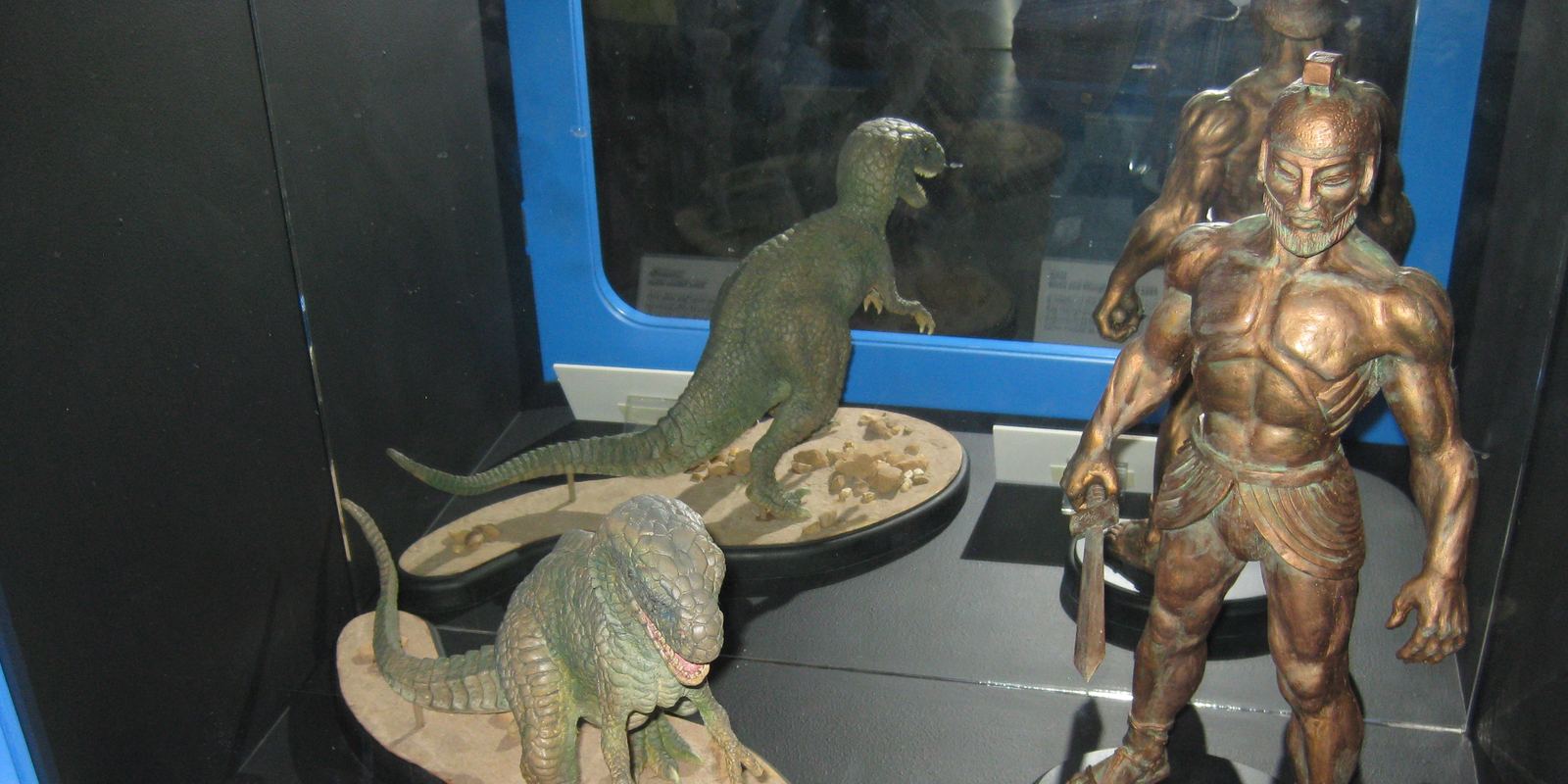
Harryhausen models on display: Chemical Engineer, CC BY-SA 4.0
Inspired by a giant ape
As a teenager Ray Harryhausen saw King Kong (1933) and decided to learn how its creatures were brought to life. He began making his own dinosaur models in the family garage and sought advice from Willis O'Brien, the effects artist behind King Kong, who encouraged him to study anatomy and sculpture.
Working with O'Brien
Harryhausen made fairy-tale puppet shorts and then joined O'Brien on Mighty Joe Young (1949), doing most of the animation of the gorilla. The film won the Academy Award for special effects. Harryhausen soon struck out on his own with films about giant creatures.
Dynamation
Harryhausen worked largely alone, animating every creature himself. His process, called Dynamation, split the live-action background into foreground and background areas so a model could appear to stand behind and in front of real elements, like a rock or an actor's arm. Animating a complex scene could take months.
Myths come alive
His most celebrated films include The 7th Voyage of Sinbad (1958), with a one-eyed giant and a dragon, and Jason and the Argonauts (1963), in which seven skeletons spring up from the ground. The skeleton scene took months to animate and is often called one of the greatest stop-motion sequences ever. His final feature was Clash of the Titans (1981).
Legacy
Filmmakers including Steven Spielberg, George Lucas, Peter Jackson, Tim Burton and Nick Park have spoken about his influence. He received the Gordon E. Sawyer Award, an Oscar for technical contributions, in 1992. His models and drawings are preserved by the Ray and Diana Harryhausen Foundation. Read our stop-motion page for more about the technique.
How he worked
Harryhausen built most of his own models, with ball-and-socket metal armatures inside foam rubber bodies. He often animated alone in a small studio for months on a single film, moving each creature a tiny amount and checking the live-action plate projected behind it. For the skeleton sequence in Jason and the Argonauts, he had to move seven skeletons and match them to actors' movements frame by frame.
Where to start: The 7th Voyage of Sinbad (1958) and Jason and the Argonauts (1963) show his imagination at its peak, and documentaries about his career include interviews with the filmmakers he inspired.
- Harryhausen models on display: Chemical Engineer, CC BY-SA 4.0
Text written by Fantastic Cartoon.