The Multiplane Camera
Giving flat drawings real depth. Layers of painted glass, spaced apart and moved separately, gave hand-drawn films a feeling of depth. How the multiplane camera worked and who built it.
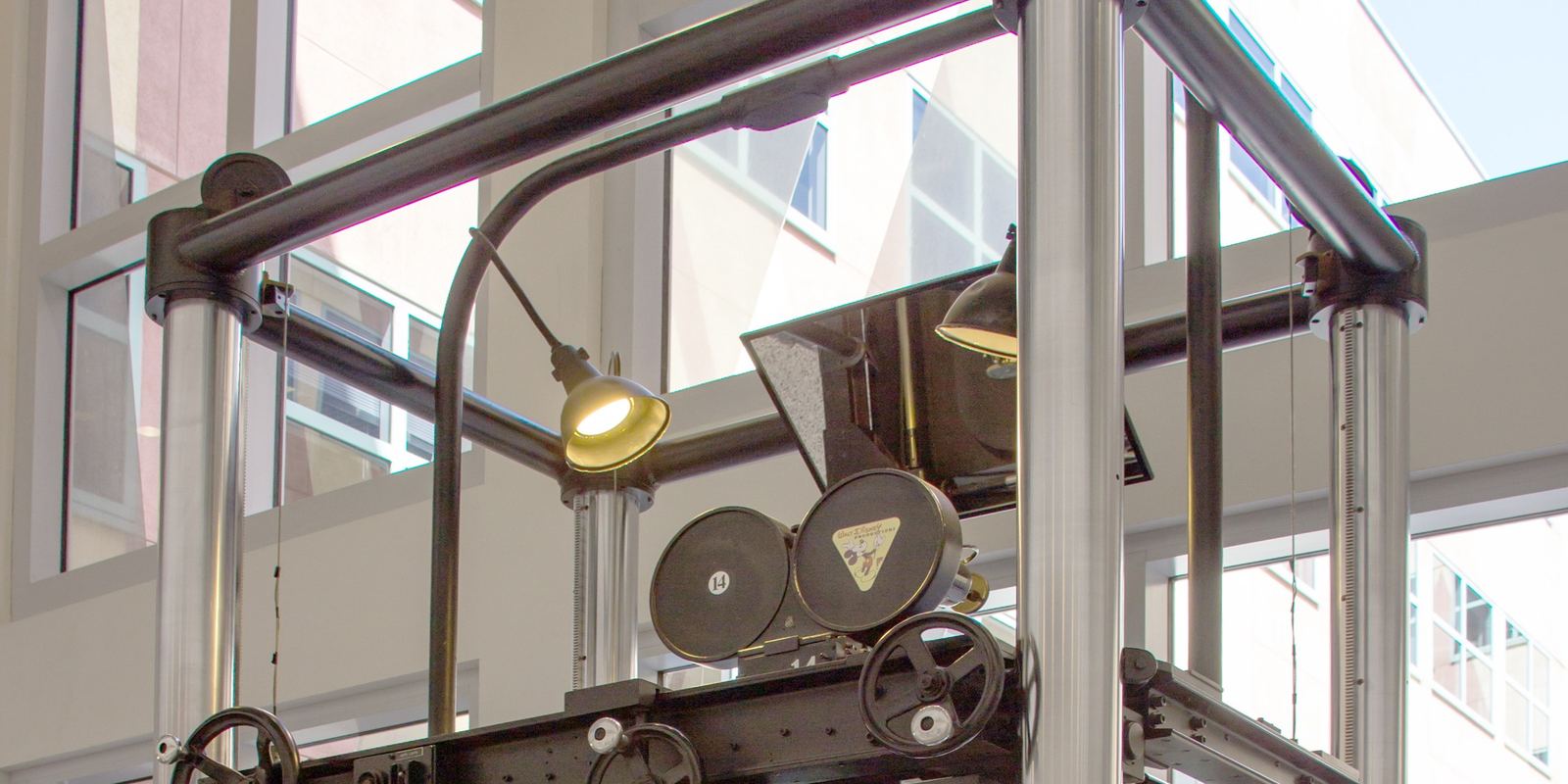
Disney's 1937 multiplane camera: HarshLight from San Jose, CA, USA, CC BY 2.0
The problem with flat art
In normal cel animation the camera looks straight down at a flat stack of artwork. When the camera moves toward the picture, everything grows at the same rate, so the scene looks like a photograph being enlarged rather than a journey into space. Animators wanted the foreground to rush past while distant mountains moved slowly, as they do in real life.
Layers of glass
The multiplane camera solved this by spreading the artwork across several horizontal sheets of glass, stacked one above another with gaps between them. The camera sat at the top, pointing down. Foreground trees might sit on the top layer, characters in the middle and the sky at the bottom. Each layer could be moved and lit separately, creating natural parallax and soft focus.
Who invented it
The idea grew over time. In the 1920s Lotte Reiniger's team used layered glass for her silhouette feature, and in the early 1930s former Disney animator Ub Iwerks built his own multiplane rig. Disney's famous version, developed under engineer William Garity, was finished in 1937.
The Old Mill and beyond
Disney tested the camera on The Old Mill (1937), a short about a windmill and its animals during a storm. It won the Academy Award for animated short, and the camera itself earned a scientific and technical award. The same machine was used for scenes in Snow White and the Seven Dwarfs, Pinocchio and Bambi, especially opening shots that glide through forests and villages.
Today's digital multiplane
Multiplane shooting was slow and needed a crew to move each layer precisely. Today digital compositing software does the same job: artists separate a painted scene into layers and move a virtual camera through them. The look of drifting foregrounds and deep backgrounds in modern 2D animation comes straight from this invention. Read the Disney golden age page for more on the studio that made it famous.
Did you know?
Operating the Disney multiplane needed several technicians, and a single complex shot could take days to photograph, because every layer had to be moved by a measured amount for each frame. Lights on each level had to be balanced so that glass layers did not cast unwanted reflections. The camera on display in museums today is one of the few that survive.
You can make a simple multiplane at home: stack two or three sheets of glass or clear plastic on books, place drawings on each level, and photograph from above while moving each layer at a different speed.
- Disney's 1937 multiplane camera: HarshLight from San Jose, CA, USA, CC BY 2.0
Text written by Fantastic Cartoon.